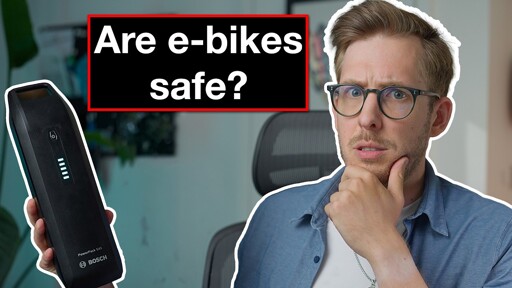
In brief, UK reporting on “ebike” collisions and battery fires confuses lawful, UK/EU-compliant electric bicycles with illegal, unregistered, uninsured electric motorcycles. As a result, public perception is deeply skewed compared to the actual risks posed by bona-fide electric bicycles.
A similar phenomenon can be seen in California, but there is drafted legislation to mandate accurate advertising of “e-motos” versus ebikes, with fines accruing to vendors that fail to correctly represent what they’re selling.
IMO, it’s hard for me to blame consumers whom, given high gasoline/petrol prices, need some form of transportation that gets them where they need to go and minimizes external harms (eg automobile risk of injury). Evan correctly identifies vendors and importers that flout the law and push the legal risk into riders. At the same time, e-motos are legit for off-road use and here in California, they’re great fun in that regard. At bottom, fair advertising isn’t controversial; it’s no different than wanting to know the ingredients in food products.
On a separate note, Evan also flagged a case of police misidentification and confiscation of a lawful e-bike. Which I find particularly surprising, given that UK police tend to be more uniformly instructed than their American counterparts. No doubt that Californian police have also confused ebikes with electric motorcycles on occasion, but the result in the UK seems is to go immediately to confiscation and destruction without any meaningful system of review. Which seems problematic, at best
Some of this confusion seems to be created or exacerbated by the industry itself, particularly in North America. The standard European ebike is limited to 250W and 25kph. But the standard North American Class 1 or 2 ebikes are limited to 20mph, with up to 750W in the US or 500W in Canada. Some Class 3 ebikes in North America are just slightly faster Class 2 bikes, but there are an awful lot of grey-area bikes that look and feel more like e-motos, and it seems like that segment of the market is popular.
I think e-motos are part of the transportation future–I own one–but I do think it would be reasonable to exclude them from sidewalks, walking paths, greenways, etc. I’m not against better regulation of this space, so long as it continues to leave actual ebikes to be treated like other bikes.
Honestly i think the big problem isn’t regulation, it’s the lack of good bike infrastructure.
People only ride on sidewalks because they feel unsafe on the road and don’t have any other option, so if you make sure there are bike paths (even if they’re shared with pedestrians, just make them wide enough) that take people where they want to go, then they’ll generally stop being a nuistance for pedestrians.And people get these pseudo-mopeds because they want the benefits of the e-bike format (lighter, less regulated, can go on bike paths) but feel a need to go fast, which isn’t helped by forcing them to share space with drivers of gargantuan vehicles that consider 30km/h to be frustratingly slow…
Another big problem is people having to travel ludicrous distances all the time, which surely contributes to this problem being so common in big cities (and the entirety of the US).My town has a really decent bike network and yeah, i don’t really ever see people going upsettingly fast other than e-scooter riders (and even then it’s not that common). People who want to go fast just get actual mopeds or motorbikes, and people who want the form factor of an e-bike don’t feel the need to go faster than 25km/h, which generally works fine since there’s enough space on the shared paths.
Then look at london, where Evan lives… Infamous for generally having bike infrastructure summed up as “slightly better than nothing” to the point where some basic fucking bike paths got branded as “bicycle superhighways”…
At least here in California, the presence of operable pedals is being rapidly adopted – in terms of consumer advice and police warnings – as a quick-and-easy distinguishing factor between an ebike and an e-moto. And it does track with the law, since there are no legal ebikes without pedals. As a way of cutting down on e-motos being sold and ridden as if ebikes, it’s a workable definition.
The drawback is that it leads to under-enforcement if that’s the only factor considered. That said, I’m less enthusiastic about focusing on enforcement when there’s genuine confusion in the marketplace about the thing that parents are buying for their children. I hazard to guess that a fair number of them would regret their purchase if informed that they actually bought a motorcycle capable of freeway speeds.
think it would be reasonable to exclude them from sidewalks, walking paths, greenways
This aspect of enforcement, I can agree with. And indeed, California strikes some sort of balance with class 1/2 being allowed but subject to the general 15 MPH limit on trails and multiuse paths, and class 3 being prohibited on most off-street surfaces.
This works fairly well for me, since I use my class 3 ebike for traversing long routes between suburbs, so operating in on-street bike lanes is simultaneously faster and more efficient for me than using the sidewalk. I’m a big fan of giving different users the space they need. And the USA is sorely in need of allocating more space for people than for cars.
so wait, are normal bikes allowed on sidewalks and walking paths? That sounds insane to me, what’s the point of pedestrian-only things if they’re not pedestrian-only?
And how is even the slowest bicycle compatible with people walking on narrow sidewalks? On separate paths i can sorta get it, there’s at least room for people to just walk to the side when a cyclist passes, though still i question calling that a “walking path” when people bike there…
are normal bikes allowed on sidewalks and walking paths
In California, yes, that’s the default rule. Municipalities have limited authority to regulate road traffic, but can prohibit bikes from sidewalks if they post certain signs. As a result, most municipalities here allow it, with some downtown areas having restrictions where sidewalks are in heavy use.
pedestrian-only things
Sadly, the pre-1900 American conception of the sidewalk as a pedestrian refuge – paved, free of mud and puddles, in an era where unpaved roads and horse carriages were the norm – was entirely sidelined in the automobile industry’s desire to move product. It would be great if municipalities actually maintained their sidewalks – in the Western USA, most states make it the responsibility of the adjacent landowner – but seeing as they’re not even required to provide sidewalks, it’s truly a block-by-block situation.
As a result, there’s every incentive to reuse sidewalks for anything that can use them, despite the obvious walkability problems, issues for people that must use the sidewalk (eg wheelchair users), while also eating the risk of sidewalks not being designed for any wheeled device (and sometimes having no regard for sight lines that would give pedestrians a chance to see an automobile running a stop sign). The very existence of sidewalks in some places has been used to justify not building additional infrastructure for separate uses, such as bike lanes, based on the false premise “nobody bikes, so no need to build infra”, which is obviously why nobody bikes. Some places only have a disconnected sidewalk segment because a building (eg school) required it for ADA compliance.
Note that a sidewalk can be properly upgraded to a multi-use path (MUP) that can support mixed traffic (eg bikes, class 1/2 ebikes, (e)scooters, dog walkers, strollers, and pedestrians) but these have to be much wiser (>3 meters) and are only designed for low traffic volumes. MUPs easily reach their design volume if, say, a school has ended class and all the students are walking home.
For the narrowest of legacy sidewalks (ones which would fail the ADA requirements today but are grandfathered if they’re left unchanged since installation pre-1990) of maybe 1 meter wide, you are correct that there’s no way for a pedestrian and bicyclist to fit in this space. The common result is that the pedestrian steps off and the bicyclist gets by. Under the law, it’s supposed to be the other way around, and IMO, it’s a lot easier for bikes to ride over grass or surfaces adjacent to the sidewalk.
I agree that pedestrians should have first dibs on sidewalks. The present reality is that this is all artificial scarcity: there’s plenty of road space that should be rededicated from automobile lanes or parking so that sidewalks are widened and pedestrians and cyclists have the space they need. This simultaneously solves the e-scooter parking issue, reduces automobile congestion and driving speeds and collisions in cities, and improves air quality and civic life.
The modern automobile is quite good at traveling long distances. So there should be no genuine complaint with having cars drive the long way around a neighborhood or business district, so that pedestrians and cyclists can go the direct route to the front door. Through streets for cars don’t need to exist; use movable bollards to allow emergency vehicles to drive into pedestrian areas
The drawback is that it leads to under-enforcement if that’s the only factor considered.
Yeah … let me just slap some pedals on my Harley and tear up the bike paths.
It’s more than just the speed and power. The form factor of fat bike mopeds has created a vicious cycle of bikes being heavier, therefore needing more power, and being more powerful allowing them to be heavier, to the point where they essentially require throttles to operate.
My rule is that if you can’t carry it up a flight if stairs or start from a stop on a hill with only the pedals, then it shouldn’t qualify, regardless of power or speed. Really, just banning throttles would solves 90% of the issue.
buddy i’m not sure most people can start from stop on a hill on a normal bike, nor carry it up the stairs (due to size if nothing else).
Are you a sports cyclist?I like your rule about starting on a hill or carrying up the stairs. That’s a real bike.
Having said that, I do like a throttle on an ebike for getting off the line with a heavy load of groceries. 😄
It’s really only an issue with cadence sensors. I’ve never had an issue starting with a load on a torque sensing bike because the assist is immediate. If we banned throttles, I think we’d just see a lot of the worst offender, shitty cadence sensing bikes become non viable and a lot more torque sensing options. It would eliminate the cheapest segment initially, but I think that’s ok. Eventually the better tech would get cheaper.
The other big problem is that so many people use the throttle as a crutch because they don’t have the basic skills to be in the right gear based on the situation. This is again just very basic safe operator fundamentals.
I’ve seen a lot of people think that motorcycle = ebike. They see kids doing wheelies on emotos and clutch their pearls and attack ebikes instead.
Part of the problem there is that these emotos are often sold and marketed as ‘ebikes’.
Well, because the lack of proper categorization and enforcement, those emotos ARE legally ebikes in a lot of places.
Nowhere in the USA though, US federal law states an ebike must have 750W of power or less, and lots of states use the 3 class system as well on top of that.
I love my E-bike and EV. I get to laugh as I pass gas stations that are selling fuel at $5.60 a gallon for regular and $7 for diesel. I actually use my bike and the trolley more than my car to get around
deleted by creator
Sounds to me like most of your complaints are about e-motos, not e-bikes.
deleted by creator
In the US e-bikes are legally capped by the manufacturer at 28mph, so anything faster than that should be categorized as an e-moto, even if it visually resembles a bicycle.
Not sure about other countries but I think they’re generally the same or lower.
I’m not sure how it is in the US (I think it varies by state?), but where I am at least, a Class 3 28 mph e-bike would be considered a road vehicle. You would not be allowed to ride those on trails. Legally, they differ from motorcycles only in that they do not require a licence and insurance.
Trail-rated e-bikes top out at Class 2 20 mph. In the UK where the guy in the video lives, it sounds like Class 1 15 mph is as high as you can go legally?
Incidentally, even with a class 3, I think the throttle mode (where you don’t need to pedal) is required to top out at 20 mph in most jurisdictions? The higher speeds are only allowed with pedal-assist. Some people remove the pedals altogether on a class 3, and that is illegal where I am.
Anyway, if you see people sailing by at high speeds on trails, this is not legal in most places. The man in the video was trying to push for more clarity in the media that it is the illegal ebikes that are giving all the others a bad name.
Yes, I totally agree with you.
The US is a bit complicated because there aren’t really national laws governing trail usage. Most are managed by local municipalities and the rules vary. However, anecdotally I will say that most do not allow class 3 e-bikes. I know mine do not. However, based on comments I see it appears the rules are widely flouted.
However, anecdotally I will say that most do not allow class 3 e-bikes. I know mine do not. However, based on comments I see it appears the rules are widely flouted.
Yeah, they’re technically not allowed in a lot of places. But there’s absolutely zero enforcement of this.
Part of the problem is that enforcement would be a huge pain. The difference between a legal and an illegal ebike is often impossible to discern at a distance, so actual effective enforcement would require stopping and closely inspecting all suspicious-looking ebikes, which would be a huge pain for people who are riding legal ones. (And would cost a lot of money to pay the enforcers.)
Yeah I agree with you. Not to mention the potential violence any amount of police involvement inevitably brings.
However it’s starting to feel like there needs to be some kind of solution. If we don’t come up with a good one, a bad one may be forced on us. Unfortunately, I don’t really have any easy fixes.
It is trivial to hack them to 40 mph.
But this is the danger of relative speed differences. 28 mph into a pedestrian could kill them.
Honestly, on my regular analog bike, I rarely get above 15mph. 10-12mph is normal cruising speed. And hitting low to mid 20s on a downhill quickly starts to feel very dangerously fast.
28mph is already a very generous speed limit, and IMO it should honestly be lower than that. (Outside of certain specialty applications, perhaps.)
For reference: 10mph=16km/h, 15mph=24km/h, 20mph=32km/h, 28mph=45km/h
Over here 28mph is literally the speed limit for mopeds, it’s frankly an insane speed to reach on anything with pedals and you should never be going that fast without at least some heavy clothing and a proper helmet that protects the side of the head and ideally has a visor.
I think something like 30-35km/h would be a sensible speed limit for american-style e-bikes, provided that goes along with a legal requirement to wear a helmet on such vehicles. It’s fast enough that you can avoid riling up car drivers (and you can get places quickly) but slow enough that you’d hopefully avoid any debilitating injuries (provided you’re wearing a helmet). I would however want them banned from many smaller bike paths, treating them as pseudo-mopeds.
And frankly 25km/h is slightly questionable as a speed limit for normal e-bikes, just nudging it down to 23km/h makes a big difference in how safe and comfortable it feels both for the rider and for those around them. I wouldn’t be upset if they were limited to 20km/h, provided there’s also the faster pseudo-moped class to serve as a complement.
It’s very hard for most people to sustain 28mph on a bicycle.
I think this is one solution that should have a widespread consensus which is to mandate manufacturers make them harder to de-limit and hold them accountable if they fail to do so.
deleted by creator
I will say 28 can feel pretty fast when it’s whizzing right by you. It sounds low if you’re used to being in a driver’s seat but it’s not.
I think this gets contentious because on streets, it’s obviously safer for pedestrians for people to ride an e-bike than drive. And the higher speeds can be really crucial for people with longer commutes. Since I ride and walk mainly on city streets I’ve usually been against further regulation because I worry it will prevent people from moving away from cars that are way way more dangerous.
But I keep hearing people people talk about mixed use trails, and there it obviously can be a safety issue. I’m not really sure what the best solution is. Ideally something that limits the conflict on trails but still allows people to ride in the road.
It also seems like it must be demographically or geographically concentrated somehow because I’ve seriously never had an issue feeling threatened by a fast e-bike and I ride my (acoustic) bike every day.
Even 20mph past someone walking is too fast. Unfortunately, that seems to be the norm for acoustic cyclists around here. I’m sure people on ebikes do it too, but I don’t see them much.
I agree but what’s the solution? Ideally separate walking and cycling paths but I don’t really see that happening.
deleted by creator
That’s exactly my point: if they can go faster than 28mph they are e-motos not e-bikes.
deleted by creator
You cannot tell by looking the difference between an ebike and an emoto. However an emoto will go much faster.
I’m assuming level ground. Down hill they both (and an acoustic bike) can all get going dangerously fast.
deleted by creator
I would expect rental bikes to only really be viable in busy places where there are a lot of pedestrians. Bikes are unsafe in those areas. Even a normal acoustic bike on a slight uphill is going to be too fast to share a path with pedestrians.
What we need in busy situations is 4 different types of trails. One for those acting like a pedestrian, one for those acting like an acoustic bike, one for that acting like a slow speed car, and one for those acting like a high speed car. Acting is important, often you can choose to operate in different ways. However these is extremely expensive and needs a lot of space so we almost always compromise and put two different uses into one and then the conflicts you describe happens: there is no easy/cheap solution.
Sure… of course they can be dangerous.
But that’s why you get pushback when you complain about “e-bikes”: there’s a big difference in the danger and you paint with too broad a brush.
Mass and speed make all the difference and there’s an order of magnitude difference to an e-moto:
- acoustic bike (10 kg, 20 km/h = 29 kN)
- e-bike (20 kg, 30 km/h = 73 kN)
- small e-moto (60 kg, 55 km/h = 340 kN)
(Assuming 85 kg / 190-lb rider for all cases and typical speeds)
deleted by creator
E-Bikes are legally limited to 28mph max in the US as Class 3 (20mph on most trails as Class 1), and 15.5mph in the EU.
I think the current laws just need better enforcement, ebikes already have perfectly reasonable speed limits in the US defined by law, and typically aren’t allowed on bike paths or sidewalks in many places. But the enforcement is lacking, and instead states constantly try to create more and more ebike laws that just won’t get enforced either.
i really don’t think 28mph is a reasonable speed limit for something that’s supposed to be a bicycle, there’s no way to pedal that fast and hitting someone at that speed can very well be lethal.
That’s not to say such vehicles should be banned or anything, but they should be counted as light mopeds and basically the only legal difference should be that they maybe don’t require a registration. They should still require a license and helmet at the very least.
The average fit road cyclist can hit 28mph+ if they sprint or are on a slight hill, I never got the concept that bicycles don’t go that fast vs ebikes, they’re often just as fast with a good rider.
Requiring helmets is always good though, plus ebikes shouldn’t be riding with pedestrians at 28mph, most mixed paths either ban ebikes or limit to class 1 at 20mph, often with lower speed limits listed on paths too.
was 100% an ebike rented from a local company
This is precisely the sort of deceit which California’s draft legislation would penalize. There’s an implicit focus on Southern California, where tourists not familiar with local laws are convinced by sketchy shops that an e-moto is “just a bicycle”. The idea is that by firmly defining what an e-moto is, it becomes a form of fraud or unfair business practice to advertise as an “ebike rental shop” but actually be flogging e-motos.
I’m not aware of any other US State which is addressing this angle, so you may want to speak to your representative about misbehaving shops in your area.
I don’t know why you’ve chosen to dismiss my concerns here.
I’m aware this wasn’t directed at me, but please be mindful that when someone presses on the substance of your complaint, they may be trying to understand the attendant context, not because they want to belittle the consequences you’ve witnessed. And it matters, because the worst case scenario is to misidentify the root-cause and pass legislation that villifies the wrong party, while letting the real wrongdoers continue harming the public.
There are real costs to just throwing ideas into law. If you’re being chronically “shouted down” by others for supposed anti-ebike opinions, it may help to try understanding their context for why they view your opinion as such.
deleted by creator
deleted by creator
No one is afraid of ebikes.