
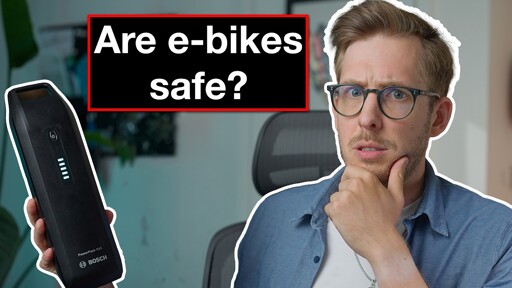
In brief, UK reporting on “ebike” collisions and battery fires confuses lawful, UK/EU-compliant electric bicycles with illegal, unregistered, uninsured electric motorcycles. As a result, public perception is deeply skewed compared to the actual risks posed by bona-fide electric bicycles.
A similar phenomenon can be seen in California, but there is drafted legislation to mandate accurate advertising of “e-motos” versus ebikes, with fines accruing to vendors that fail to correctly represent what they’re selling.
IMO, it’s hard for me to blame consumers whom, given high gasoline/petrol prices, need some form of transportation that gets them where they need to go and minimizes external harms (eg automobile risk of injury). Evan correctly identifies vendors and importers that flout the law and push the legal risk into riders. At the same time, e-motos are legit for off-road use and here in California, they’re great fun in that regard. At bottom, fair advertising isn’t controversial; it’s no different than wanting to know the ingredients in food products.
On a separate note, Evan also flagged a case of police misidentification and confiscation of a lawful e-bike. Which I find particularly surprising, given that UK police tend to be more uniformly instructed than their American counterparts. No doubt that Californian police have also confused ebikes with electric motorcycles on occasion, but the result in the UK seems is to go immediately to confiscation and destruction without any meaningful system of review. Which seems problematic, at best
In the US e-bikes are legally capped by the manufacturer at 28mph, so anything faster than that should be categorized as an e-moto, even if it visually resembles a bicycle.
Not sure about other countries but I think they’re generally the same or lower.
I’m not sure how it is in the US (I think it varies by state?), but where I am at least, a Class 3 28 mph e-bike would be considered a road vehicle. You would not be allowed to ride those on trails. Legally, they differ from motorcycles only in that they do not require a licence and insurance.
Trail-rated e-bikes top out at Class 2 20 mph. In the UK where the guy in the video lives, it sounds like Class 1 15 mph is as high as you can go legally?
Incidentally, even with a class 3, I think the throttle mode (where you don’t need to pedal) is required to top out at 20 mph in most jurisdictions? The higher speeds are only allowed with pedal-assist. Some people remove the pedals altogether on a class 3, and that is illegal where I am.
Anyway, if you see people sailing by at high speeds on trails, this is not legal in most places. The man in the video was trying to push for more clarity in the media that it is the illegal ebikes that are giving all the others a bad name.
Yes, I totally agree with you.
The US is a bit complicated because there aren’t really national laws governing trail usage. Most are managed by local municipalities and the rules vary. However, anecdotally I will say that most do not allow class 3 e-bikes. I know mine do not. However, based on comments I see it appears the rules are widely flouted.
Yeah, they’re technically not allowed in a lot of places. But there’s absolutely zero enforcement of this.
Part of the problem is that enforcement would be a huge pain. The difference between a legal and an illegal ebike is often impossible to discern at a distance, so actual effective enforcement would require stopping and closely inspecting all suspicious-looking ebikes, which would be a huge pain for people who are riding legal ones. (And would cost a lot of money to pay the enforcers.)
Yeah I agree with you. Not to mention the potential violence any amount of police involvement inevitably brings.
However it’s starting to feel like there needs to be some kind of solution. If we don’t come up with a good one, a bad one may be forced on us. Unfortunately, I don’t really have any easy fixes.
Well, there’s the possibility of enforcement at the manufacture/import/sale level. Make it illegal to manufacture/import/sell any ‘ebike’ that’s too powerful or too fast. (Defined as any vehicle in the general shape of a bicycle or tricycle, having bicycle-like pedals, and exceeding speed/power limits.)
That moves enforcement away from the street level, making it less difficult and less dangerous.
You’ll still have some issues with previously existing overpowered ebikes, and from the occasional person who builds/modifies a DIY one of their own, but that will be much rarer and much less of a problem than what we have now, where anybody can buy one off of Amazon at any time … often maybe not even realizing what exactly it is that they’re buying.
It is trivial to hack them to 40 mph.
But this is the danger of relative speed differences. 28 mph into a pedestrian could kill them.
Honestly, on my regular analog bike, I rarely get above 15mph. 10-12mph is normal cruising speed. And hitting low to mid 20s on a downhill quickly starts to feel very dangerously fast.
28mph is already a very generous speed limit, and IMO it should honestly be lower than that. (Outside of certain specialty applications, perhaps.)
It’s very hard for most people to sustain 28mph on a bicycle.
For reference: 10mph=16km/h, 15mph=24km/h, 20mph=32km/h, 28mph=45km/h
Over here 28mph is literally the speed limit for mopeds, it’s frankly an insane speed to reach on anything with pedals and you should never be going that fast without at least some heavy clothing and a proper helmet that protects the side of the head and ideally has a visor.
I think something like 30-35km/h would be a sensible speed limit for american-style e-bikes, provided that goes along with a legal requirement to wear a helmet on such vehicles. It’s fast enough that you can avoid riling up car drivers (and you can get places quickly) but slow enough that you’d hopefully avoid any debilitating injuries (provided you’re wearing a helmet). I would however want them banned from many smaller bike paths, treating them as pseudo-mopeds.
And frankly 25km/h is slightly questionable as a speed limit for normal e-bikes, just nudging it down to 23km/h makes a big difference in how safe and comfortable it feels both for the rider and for those around them. I wouldn’t be upset if they were limited to 20km/h, provided there’s also the faster pseudo-moped class to serve as a complement.
I think this is one solution that should have a widespread consensus which is to mandate manufacturers make them harder to de-limit and hold them accountable if they fail to do so.
deleted by creator
I will say 28 can feel pretty fast when it’s whizzing right by you. It sounds low if you’re used to being in a driver’s seat but it’s not.
I think this gets contentious because on streets, it’s obviously safer for pedestrians for people to ride an e-bike than drive. And the higher speeds can be really crucial for people with longer commutes. Since I ride and walk mainly on city streets I’ve usually been against further regulation because I worry it will prevent people from moving away from cars that are way way more dangerous.
But I keep hearing people people talk about mixed use trails, and there it obviously can be a safety issue. I’m not really sure what the best solution is. Ideally something that limits the conflict on trails but still allows people to ride in the road.
It also seems like it must be demographically or geographically concentrated somehow because I’ve seriously never had an issue feeling threatened by a fast e-bike and I ride my (acoustic) bike every day.
Even 20mph past someone walking is too fast. Unfortunately, that seems to be the norm for acoustic cyclists around here. I’m sure people on ebikes do it too, but I don’t see them much.
I agree but what’s the solution? Ideally separate walking and cycling paths but I don’t really see that happening.
Just get rid of the car paths and there’d be no problem with getting separate paths. An option with more of a chance of happening would be just giving cyclists protected bike lanes on roads instead of just having them share the lane with cars going 40 mph.
Well as you point out this isn’t super likely to happen any time soon but also it doesn’t address what seems to be the main point of contact which is shared use bike trails in parks. I suppose you could add a second parallel trail for just pedestrians but that seems quite expensive.
The suggestion is a parallel bike path when possible… Just on the road instead of on the trail. Of course some will choose to use the trail as long as cars poison us…
You’re missing the point. Most of these trails don’t have a parallel road.
Just making the shared paths as wide as possible and segregating it with a painted line does a lot, shared paths are bog standard here in sweden and while obviously it’s not ideal it does generally work perfectly fine and can scale up to handle pretty significant amounts of traffic.
If you can make the path 5m wide and give pedestrians 2m and cyclists 1.5m in each direction, that’s comfortable for basically anyone even with cyclists going quite fast.
deleted by creator