It is, but conceptually it’s a lot weirder than the Fourier transform, whose idea at least is very straightforward. I mean, when doing Laplace transforms you do have to assume that int(e^tdt){0}{∞}=-1. I’d definitely rather use the Laplace transform, but you couldn’t pay me to explain how that shit actually works to an undergrad student.
Basically the assumption is that the signal x(t) is equal to 0 for all t < 0 and that the integral converges. And what is a bit counter-intuitive: Laplace transformations can be regarded as generalizations of Fourier transformations, since the variable s is not only imaginary but fully complex. But yeah… I would have to brush up on it again, before explaining it as well. It’s… been a while.
I was at the intersection between mechanical and electrical engineering as well as computer science. And worked in/with (electric) mobility, agriculture, medical/rehabilitation tech., solar energy, energy grid, construction and building tech. As well as some very limited stuff with economics. And I intentionally chose my study courses to be able to work in multiple areas and inter-disciplinary. My latest work is more on the business and management side of things and less technical, though.
What are you studying and what direction are you hoping to head in?


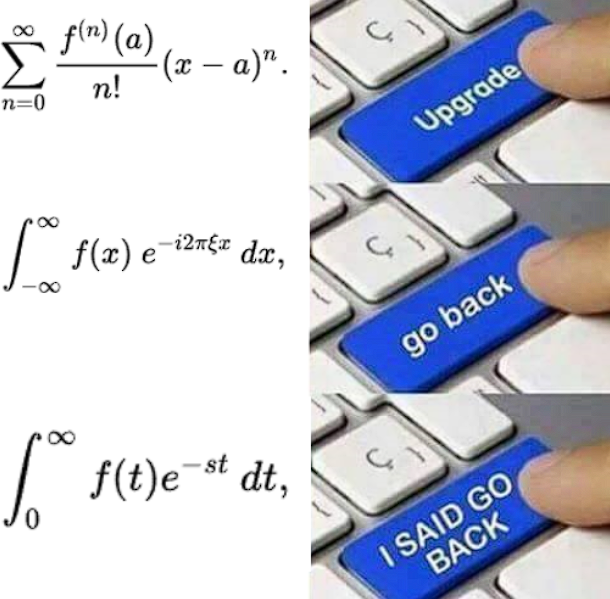
Oh, look at that hornet’s nest. I wonder what happens if I poke it
As someone who worked with system modelling, analysis and control for years… I do think the Laplace transform is easier to work with 🙈🏃♂️
It is, but conceptually it’s a lot weirder than the Fourier transform, whose idea at least is very straightforward. I mean, when doing Laplace transforms you do have to assume that int(e^tdt){0}{∞}=-1. I’d definitely rather use the Laplace transform, but you couldn’t pay me to explain how that shit actually works to an undergrad student.
Basically the assumption is that the signal x(t) is equal to 0 for all t < 0 and that the integral converges. And what is a bit counter-intuitive: Laplace transformations can be regarded as generalizations of Fourier transformations, since the variable s is not only imaginary but fully complex. But yeah… I would have to brush up on it again, before explaining it as well. It’s… been a while.
What kind of work do you do?
I’m in the process of wrapping up my degree and I work a lot with signals and controls. I agree that Laplace is much less of a headache than Fourier.
I was at the intersection between mechanical and electrical engineering as well as computer science. And worked in/with (electric) mobility, agriculture, medical/rehabilitation tech., solar energy, energy grid, construction and building tech. As well as some very limited stuff with economics. And I intentionally chose my study courses to be able to work in multiple areas and inter-disciplinary. My latest work is more on the business and management side of things and less technical, though.
What are you studying and what direction are you hoping to head in?