

- cross-posted to:
- worldnews@lemmy.ml
- cross-posted to:
- worldnews@lemmy.ml
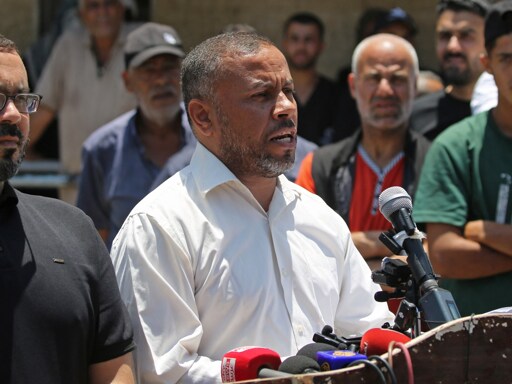
The Palestinian group Hamas has announced the dissolution of the body that has governed Gaza for nearly two decades, paving the way for a technocratic committee to implement civilian rule in the war-ravaged, besieged territory.
The move on Monday marks a significant political shift by Hamas, which has governed Gaza since its fighters seized control from rival Palestinian movement Fatah in 2007 after Hamas won legislative elections the previous year.
A Hamas official said the group wished for the swift entry of the National Committee for the Administration of Gaza (NCAG), a body which is tasked with overseeing the future administration of Gaza under a US-backed plan to end Israel’s genocidal war on the Palestinian territory.
You must log in or # to comment.
This is probably fine as long as they can suffer the shenanigans from the Board of Peace until 2029. The problem is that the UN gave an implementation mandate to the Board of Peace. This is extremely problematic as the Board of Peace lacks credibility and its leadership structure is completely centralised around its chairman for life, Donald Trump.
After the next US president takes office, I think it’s highly likely that the United States will use the threat of withdrawing from the Board of Peace and freezing its bank accounts (the Board has an account at the World Bank which is empty; all funds are currently held in a private account under the control of Trump at JP Morgan, an American bank) to force Donald Trump out of the position of chairman, or try to get the Security Council to withdraw the mandate. If the US withdraws all support from the Board of Peace, it would probably crumble without access to American resources. This would provide a good reason to transfer the mandate away from the Board to the UN’s own Trusteeship Council. At least the Trusteeship Council has a reputation for mediocrity when it comes to overseeing its territories.
well with hamas out the way peace must be just round the corner
We all know Hamas is really an Israeli-funded organization. There’s no credibility there.
Wildly stupid take
Its not a take when there’s evidence.
a bit more background on this sourcd.
from the electronicintifada wikipedia page.
- "founded in February 2001[2] by Ali Abunimah, Arjan El Fassed, Laurie King, and Nigel Parry.[3]
In April 2008, The Electronic Intifada published an article containing e-mails exchanged by members of the Committee for Accuracy in Middle East Reporting in America (CAMERA).[4] The stated purpose of the group was “help[ing] us keep Israel-related entries on Wikipedia from becoming tainted by anti-Israel editors”.[5][4][6] Five Wikipedia editors involved in a CAMERA campaign were sanctioned by Wikipedia administrators, who wrote that the project’s open nature “is fundamentally incompatible with the creation of a private group to surreptitiously coordinate editing by ideologically like-minded individuals”.[5]
After Al Jazeera decided not to publish The Lobby, its documentary about the pro-Israel political lobby in the US,[7][8] The Electronic Intifada published a leaked version online in 2018.[9][10][11]"
-Conflict with NGO Monitor over Dutch funding
"In 2010, the Jerusalem-based pro-Israel organization NGO Monitor criticized the Dutch Interchurch Organisation for Development Cooperation (ICCO) for providing financial support to The Electronic Intifada, which it said was antisemitic and compared Israeli policies with those of the Nazi regime.[12] Gerald M. Steinberg, head of the organization, described The Electronic Intifada as “an explicitly pro-Palestinian political and ideological Web site”[13] that hosts “anti-Israel propaganda.”[14] Marinus Verweij, chairman of ICCO’s executive board said “The EI reports frequently about the violations of human rights and international humanitarian law by the State of Israel. In no way is the EI anti-Israel or anti-Semitic.”[12] He described The Electronic Intifada as “an important source of information from the occupied Palestinian territories” frequently used by newspapers such as The Washington Post and the Financial Times.[12]
Dutch Foreign Ministry spokesman Ward Bezemer stated that whether ICCO had promoted antisemitism, a criminal offence, is to be determined by the Public Prosecutor on the basis of Dutch law. On 26 November 2010, Dutch Foreign Minister Uri Rosenthal, who is Jewish and has an Israeli wife, said: “I will look into the matter personally. If it appears that the government subsidized NGO ICCO does fund The Electronic Intifada, it will have a serious problem with me.”[12] Rosenthal later told IKON radio that “anti-semitism is not the issue” but “my concern about calls to contribute to boycotts and embargoes”.[15]
EI co-founder MP Arjan El-Fassed, who also wrote for the website Al-Awda, told the Dutch newspaper De Volkskrant that the complaint by NGO Monitor was related to one quote from an interview with Jewish Holocaust survivor and anti-Zionist Hajo Meyer in June 2009. Meyer told EI: “I can write up an endless list of similarities between Nazi Germany and Israel.”[16] In the same article, the Director of the Centre for Information and Documentation Israel (CIDI), Ronnie Naftaniel, said that The Electronic Intifada is not an antisemitic website. He stated that, while everybody should be free to express their opinion, the Dutch government should not indirectly fund a website that regularly calls for a boycott of Israel.[17]
On 14 January 2011, ICCO decided not to change its policy after a discussion held with the Dutch foreign minister.[18] In response to ICCO’s decision, The Jerusalem Post reported that Dutch Foreign Minister Uri Rosenthal “will monitor ICCO’s activities. He will consider this as a minus when he makes up the balance when ICCO applies again in a new subsidies round,” as said by Ward Bezemer, a spokesman for Rosenthal."[19] Partos, a national umbrella for more than a hundred Dutch civil society organizations in the international development cooperation sector, strongly condemned Rosenthal’s threats to ICCO’s funding. “Rosenthal’s position vis-à-vis ICCO creates a dangerous precedent for the future. Development organisations will have to continue to fight for an independent voice in the debate. Partos will … stand up for that.”[20]
In April 2011, Professor of International Cooperation Studies Paul Hoebink argued that Foreign Minister Uri Rosenthal has no say in Dutch government funding to ICCO because Minister Ben Knapen holds the portfolio. In addition, ICCO’s contribution to The Electronic Intifada is paid with ICCO’s own funds. Professor of International Law and Dutch politicians for the Labour Party, Nico Schrijver considered Rosenthal’s threat to cut government funding if ICCO continues its financial support to The Electronic Intifada as very worrying."
Yes Zionists hate it
Is there evidence of recent Israeli funding? I know they were Israeli backed a while back
As recently as 2023, yes. They’ve been funneling money through Qatar.
Evidence? It makes sense, but this isn’t a post about Brendan Fraser looking like scooby doo.
Go learn to use a search engine please. Damn these zios are annoying
I agree, 7Oct was probably a false flag. Just thought you might have some better information than wikipedia.